
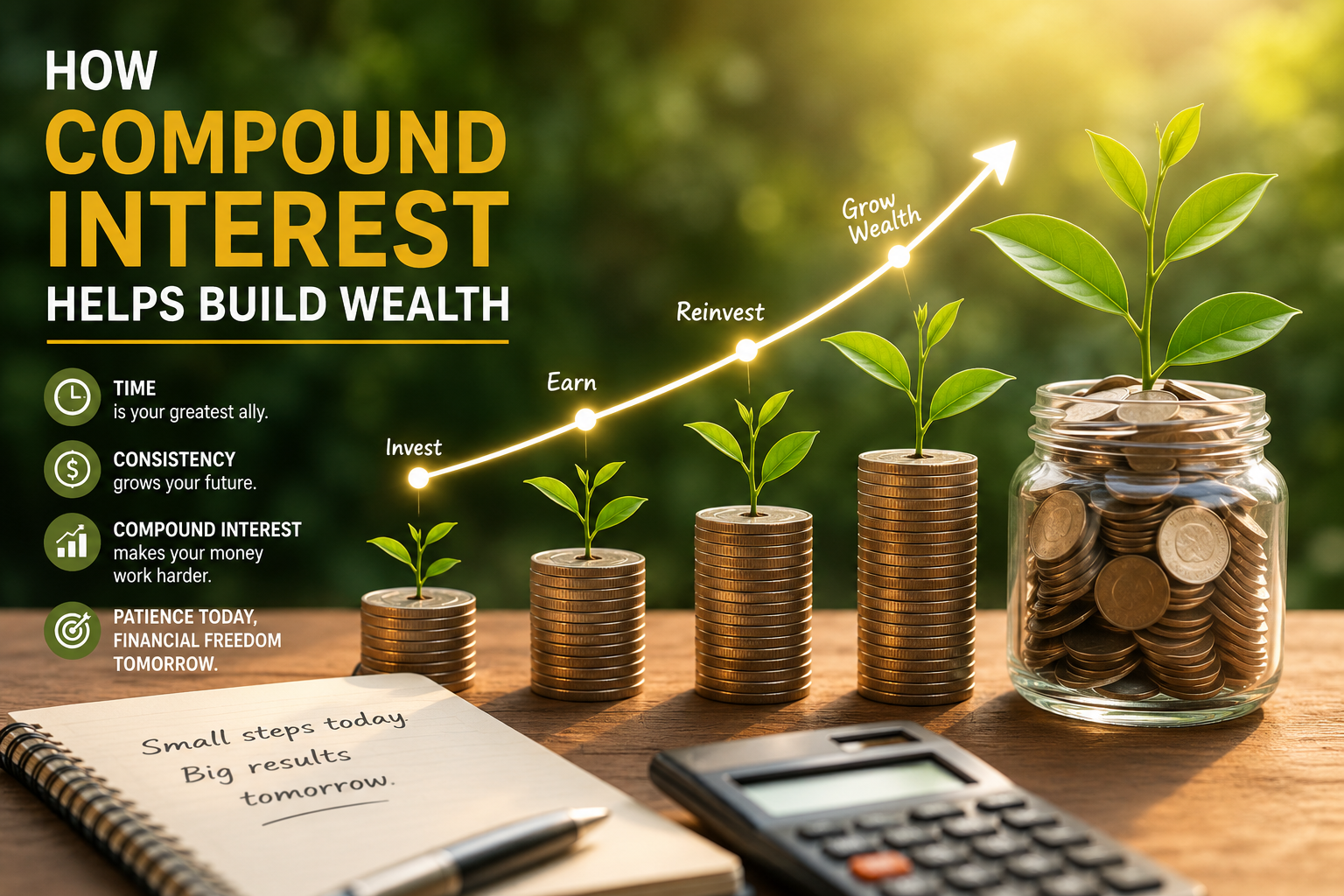
Building wealth is a goal shared by millions of people around the world. Some dream of financial freedom, while others simply want greater security and peace of mind. No matter the objective, one concept has consistently helped individuals grow their money over time: compound interest.
Compound interest is often described as one of the most powerful tools in personal finance. It allows money to grow not only from the original investment but also from the earnings accumulated along the way. While the idea may sound simple, its long-term impact can be extraordinary.
Many beginner investors focus on finding the perfect stock, the fastest-growing investment, or the next financial trend. However, the real secret behind long-term wealth creation is often consistency combined with time. Compound interest rewards patience, discipline, and steady investing habits.
Understanding how compound interest works can completely change the way people think about money. Instead of relying solely on active work to increase income, compound growth allows investments to work continuously in the background. Over time, even modest contributions can become surprisingly valuable.
This article explains compound interest in a simple and practical way. You will learn how it works, why time matters so much, how small investments can grow, and how to take advantage of compound growth to improve your financial future.
What Is Compound Interest?
Compound interest is the process where money earns returns, and those returns begin earning additional returns over time.
Unlike simple interest, which is calculated only on the original amount invested, compound interest allows earnings to accumulate on both the initial investment and previous gains.
Imagine investing $1,000 with an annual return of 10%.
With simple interest, you would earn $100 every year based only on the original investment.
With compound interest, the earnings increase each year because the investment balance keeps growing.
After the first year:
- Initial investment: $1,000
- Earnings: $100
- Total: $1,100
After the second year:
- Earnings are now calculated on $1,100
- New earnings: $110
- Total: $1,210
Over time, the growth becomes larger and faster because the investment keeps building upon itself.
Why Compound Interest Is So Powerful
The true strength of compound interest appears over long periods.
At first, growth may seem slow. Many beginners become impatient because they expect immediate results. However, compound growth accelerates over time.
This happens because each year’s gains become part of the base used to generate future returns.
The longer money stays invested, the greater the compounding effect becomes.
This is why starting early can make a huge difference.
Someone who starts investing at age 25 may build significantly more wealth than someone who starts at 40, even if the older investor contributes more money later.
Time is one of the most valuable ingredients in investing.
The Importance of Starting Early
Many people delay investing because they think they need a large amount of money to begin. In reality, starting early with small amounts is often better than waiting to invest larger sums later.
Consider two hypothetical investors:
Investor A
- Starts investing at age 25
- Invests $200 per month
- Stops investing at age 35
- Leaves the money invested
Investor B
- Starts investing at age 35
- Invests $400 per month
- Continues until age 65
Even though Investor B contributes more money overall, Investor A may still end up with similar or greater wealth because the investments had more time to compound.
This example demonstrates how powerful time can be when combined with compound growth.
How Regular Contributions Increase Wealth
Compound interest becomes even stronger when investors contribute consistently.
Adding money regularly creates a cycle of continuous growth.
Each new contribution:
- Increases the investment balance
- Generates future earnings
- Helps accelerate compounding
This is why many financial experts encourage monthly investing habits.
Even small contributions can grow meaningfully over time.
For example:
- $50 per month may not feel life-changing today
- But over several decades, consistent investing may produce substantial results
The key is consistency rather than perfection.
The Relationship Between Compound Interest and Long-Term Investing
Compound interest works best when investments remain untouched for long periods.
Frequent withdrawals interrupt growth because money removed from investments can no longer generate future returns.
Long-term investors understand that patience allows compound growth to reach its full potential.
This is one reason why retirement accounts often become valuable over time. Investments may remain untouched for decades, allowing compound growth to continue uninterrupted.
Successful investing is not always about quick profits. Often, it is about giving investments enough time to mature.
How Reinvesting Earnings Helps
Reinvesting earnings is an important part of compound growth.
Some investments generate:
- Dividends
- Interest payments
- Capital gains
When these earnings are reinvested instead of spent, they begin producing additional returns.
This creates a snowball effect.
For example:
- A stock pays dividends
- The dividends purchase additional shares
- Those shares generate future dividends
- The cycle continues
Over many years, reinvesting can dramatically increase total investment growth.
Compound Interest and Different Types of Investments
Compound growth can occur in many financial products, including:
- Savings accounts
- Bonds
- Mutual funds
- Exchange-traded funds (ETFs)
- Dividend stocks
- Retirement accounts
Different investments carry different levels of risk and return.
While safer investments may grow more slowly, higher-risk investments can potentially generate stronger long-term returns.
Choosing the right investment depends on:
- Financial goals
- Risk tolerance
- Time horizon
- Personal preferences
Diversification is often important because it spreads risk across different assets.
Common Mistakes That Reduce Compound Growth
Many people unintentionally limit the benefits of compound interest through poor financial habits.
Starting Too Late
Waiting many years to begin investing reduces the amount of time available for compounding.
Withdrawing Investments Frequently
Removing money interrupts growth and reduces future earning potential.
Trying to Get Rich Quickly
Some investors chase risky opportunities instead of focusing on consistent long-term growth.
Ignoring Fees
High investment fees can reduce returns over time.
Even small percentage differences may significantly impact long-term wealth.
Panicking During Market Declines
Market volatility is normal.
Selling investments during temporary downturns can prevent long-term recovery and future compound growth.
The Emotional Side of Long-Term Investing
Compound interest rewards emotional discipline.
Many investors struggle because emotions influence financial decisions.
Fear during market declines and excitement during market booms can lead to impulsive behavior.
Long-term investors often succeed because they:
- Stay calm during volatility
- Continue investing consistently
- Focus on long-term goals
- Avoid emotional decisions
Patience becomes a major advantage.
How Inflation Affects Compound Growth
Inflation reduces purchasing power over time.
Money kept entirely in low-growth accounts may lose value relative to rising costs.
Investing allows compound growth to potentially outpace inflation.
This is why many people invest instead of relying only on savings accounts.
While investing involves risks, long-term growth may help protect future purchasing power.
Practical Tips to Benefit From Compound Interest
Start as Soon as Possible
Even small investments can benefit greatly from time.
Invest Consistently
Regular contributions create long-term momentum.
Reinvest Earnings
Allow dividends and interest to continue compounding.
Think Long Term
Avoid focusing only on short-term market movements.
Diversify Investments
Spreading investments may reduce overall risk.
Continue Learning
Financial education helps investors make better decisions.
Technology Makes Investing More Accessible
Modern technology has made investing easier for beginners.
Today, many platforms allow people to:
- Open accounts online
- Invest automatically
- Buy fractional shares
- Track investment performance
- Learn through educational resources
This accessibility allows more people to start investing earlier and more consistently.
However, beginners should still research carefully and avoid making decisions based only on trends or social media hype.
Compound Interest and Financial Freedom
Compound growth can play an important role in achieving financial freedom.
Over time, investments may generate:
- Passive income
- Retirement savings
- Emergency reserves
- Wealth for future generations
Financial freedom does not necessarily mean extreme wealth.
For many people, it means having:
- Greater flexibility
- Reduced financial stress
- More choices in life
- Increased stability
Compound interest helps create these opportunities gradually.
Final Thoughts
Compound interest is one of the most valuable concepts in personal finance and investing. It allows money to grow steadily over time by generating earnings on both the original investment and accumulated gains.
The process may seem slow in the beginning, but patience and consistency can produce remarkable long-term results.
People do not need to be financial experts or wealthy to benefit from compound growth. Starting early, investing regularly, reinvesting earnings, and maintaining a long-term mindset can make a significant difference over the years.
In a world filled with quick-money promises and short-term distractions, compound interest reminds us that lasting wealth is often built slowly and steadily.
The earlier someone begins, the more time their investments have to grow. Even small financial decisions made today may create meaningful opportunities in the future.
Understanding compound interest is not just about learning a financial formula. It is about recognizing the value of patience, discipline, and long-term thinking in building a stronger financial life.
Parte superior do formulário
Parte inferior do formulário